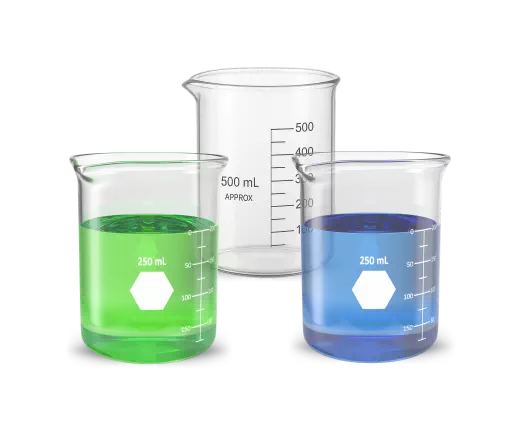
Beakers

A beaker is a simple cylindrical container with a flat bottom, usually made of borosilicate glass (like Pyrex) or plastic, and it often has a lip (spout) for easy pouring.

Shape Beakers are cylindrical shape, wide mouth and flat bottom
Spout Easy and smooth pouring.
Sizes of beaker Beakers are available in various sizes
Heat resistant Beakers are made of glass for heat tolerant.
Graduation marker clear and marked graduation.

Features of Beaker

Although there are different types of beakers, some features of all the types are similar

which are as follows:

  • The spout design enables clean and precise pouring
  • Uniform wall thickness distribution makes it easier for heating liquid
  • Large labelling field for easy marking
  • Printed in Double Scale for Easy reading
  • High Resistance to Chemical attack

Raw Material Used

Glass beakers they are usually made of borosilicate glass that can tolerate temperatures up to 400℃ and are chemical resistant.

Types of Beakers

Laboratory beakers come in a variety of shape, sizes, and materials which is broadly classified into the following types, Tall form beaker, Small form beaker, Flat beaker, Phillips beaker

Applications of Beaker

  • Beakers are used to hold solid or liquid samples as reaction containers.
  • Beakers are used for stirring liquids to prepare reagents or chemicals.
  • Berzelius beakers are used for titration experiments where solutions are mixed to generate many outcomes.
  • Flat-form beakers are used for hot bath heating in scientific laboratories.

Advantages of a Beaker

  • It is the most commonly available glassware
  • It is available in various volumes, sizes, and shapes.
  • It also can calculate liquid volume when strict accuracy is not necessary.
  • It is easier to use in the heating and mixing process.
  • The spout helps in easy pouring.